

 6:05 PM
 SS.A
SS.A

Why Can’t We Afford to Delay 3G/4G Auction?: ProPakistani |  |

- Why Can’t We Afford to Delay 3G/4G Auction?
- Launch Ceremony for Deployment of Pakistan-China Fiber Optic Cable Held
- Ufone Offers SMS Backup Service
- Pakistan Participated in APCERT Cyber Drill, It wasn’t a Competition BTW
- Telenor Rewards its Retailers
| Why Can’t We Afford to Delay 3G/4G Auction? Posted: 21 Feb 2012 08:51 PM PST
He built the organization from scratch and successfully started executing projects, worth billions of rupees, to bridge the digital divide in the country through private sector telecom service providers. As a concerned citizen, I would like to urge all those who have anything to do with the ICT sector to do whatever they can, to push and expedite introduction of mobile broadband (3G or whatever). I say this because yet another delay (albeit short and for good reasons) has appeared. Irrespective of the on-going, completely unnecessary, "controversy" surrounding auction of 3G in Pakistan, allotting 3G frequencies to telecom operators is extremely urgent and essential for Pakistan. We have already been left behind by others who used to be our followers in 2G. Mobile broadband – or 3G – should have been introduced here already four years ago. The delay has made us lose huge opportunities relating to job creation, international trade, economic growth and Foreign Direct Investment (Telecom FDI 2007: US$1,824 mil and 2011: US$ 79 mil). Not to mention letting the technology gap between the advanced countries and us widen even more, despite the fact that more than 70% of our population is below 35 – normally considered early adopters of modern technology. According to ITU's World Telecommunication/ICT Indicators Database, a total of 159 economies worldwide have launched 3G services commercially and the number of active mobile-broadband subscriptions has surpassed one billion. Countries from New Zealand to USA are allocating huge amounts of national resources to deploy infrastructure, like Optic Fiber Cables, to facilitate delivery of broadband to the citizens. Whereas we are taking ages even to allocate the God-given resource of frequency-spectrum which will facilitate provision of broadband. Some skeptics ask what we will do with 3G? Mostly they are only thinking in terms of mobile phones – and not mobile broadband. Although a lot could be done with 3G smart phones too (present estimate 15 mil smart phones in Pakistan, expected to increase to 50 mil by 2016), it is 3G mobile broadband, mainly using USB dongles, complementing fixed broadband, that is of bigger value and main attraction for countries like ours. While people in developed countries usually use mobile-broadband in addition to the fixed, mobile-broadband is often the only access method available to people in developing countries. Broadband has tremendous commercial usages but one of its main benefits lies in it's capability as a deliverer of basic services to hundreds of millions of citizens, especially those living in the hinterlands of the country. Education, Health, Governance, Commerce, Agriculture, Women Empowerment,… all can find their way. Greater access to broadband services has been found to help accelerate achievement of development targets like the internationally-agreed Millennium Development Goals. It is only using broadband that we can serve our exploding population (CAGR: 2.5%) at their doorsteps, not only to bring prosperity to them but also prevent mass migration to urban centers and save our bursting mega-cities from crumbling under their own weight. Right now in Pakistan broadband is available in less than 300, small and big, towns and cities. All the present two million connections being of fixed broadband category (50% wireless). But then there is only so much fixed technologies can do. Fortunately, thanks to the ubiquitous 2G GSM network, 3G can take broadband to every nook and corner of the country, becoming accessible to more than 90% population, with relatively small effort. I have deliberately used the word "effort" and not investment because investment will come from private sector telecom operators. Here is a sector where the government doesn't need to bother about development budget allocations and resource constraints. Just like 2G was such an effective engine of growth for our economy, 3G too could contribute significantly. Admittedly the private sector operators would like to invest and deploy 3G mainly in large cities, but for the rest there is USF! As for the controversy, firstly, on a per-megahertz-per-year basis, the announced base price is equal to the peak price achieved last time around. Secondly it is likely to go higher during bidding, despite worse political/economic/security situation than in 2004. And thirdly the licenses are going to be technology-neutral, therefore it is the operators who would decide whether they deploy 3G or something else (incidentally 4G – the so-called LTE Advanced — is not even there yet). Yes, the only thing that all of us need to be vigilant about and jealously guard is the process being followed. The process must be fair and transparent. Period. Related posts:
To read more, click: Why Can’t We Afford to Delay 3G/4G Auction?           |
| Launch Ceremony for Deployment of Pakistan-China Fiber Optic Cable Held Posted: 21 Feb 2012 08:50 PM PST
This mega telecom project will cost Rs. 3.7 billion and will accrue economic benefits to Pakistan and will establish alternate international connectivity with China, Central Asian Republics (CARS) and Europe. At present, Pakistan's international connectivity with the world is through undersea cables, that are SEA-ME-WE 3&4, IMEWE and TWA-1, and Pakistan is connected through spurs only. On completion, the project will also facilitate trade, tourism and IT awareness in the region and generate economic opportunities particularly in Gilgit-Baltistan. This cross-border fiber link is expected to generate revenue, approximately Rs 1.5 billion in the first three years and, in the fourth year, the financial dividends are likely to grow. Project is result of a Memorandum of Understanding (MoU) that was signed in April 2007, while construction and Maintenance Agreement between SCO and China Telecom (CT) was signed during the visit of Chinese Vice Premier to Pakistan in Jun 2010. SCO persistently pursued the process for its approval and the project was finally approved by the Government of Pakistan in Dec 2010. Launch ceremony for this project was held in HQ SCO. Director Development of HQ SCO gave a detailed briefing on technical aspects of the project and invited technical proposals from the firms for the execution of the project. Chairman SCO Project Management Board IGC&IT, SO-in-C, DG SCO, Member Telecom MoIT, and CEOs/Representatives of all Chinese telecom firms were also present at the occasion. Related posts:
To read more, click: Launch Ceremony for Deployment of Pakistan-China Fiber Optic Cable Held      |
| Ufone Offers SMS Backup Service Posted: 21 Feb 2012 08:49 PM PST
This service is available to all Ufone Prepaid and Postpaid subscribers How Ufone SMS Backup Works? Ufone SMS Backup is a simple and effective way to save your messages. Simply create an SMS Backup account by sending SUB 3838 or forwarding the SMS you want to save to 3838 for Rs. 0.01+Tax/SMS. After subscribing you will get a password through which you can login to your SMS Backup account on http://smsbackup.ufone.com. All your backed up SMS can be viewed on your web account. Ufone also supports automatic sync for all text messages if you are using SyncML enabled Nokia phone. Here's the list of supported phones. Click on this link to find out more about SyncML. Service Commands: Use following SMS keywords to use Ufone SMS Backup Service:
Backup & Restore Use following SMS keywords to backup or to restore SMS messages:
You can also retrieve your data by logging in your phone backup account and requesting online. Charges:
Note: Upon subscription, if the service is not utilized or paid for within 30 days, the account will automatically be suspended. The SMS Backup will, thereafter, be kept in the database for 15 days within which period, if the service is not resumed, the said backup will be removed from the database. Users shall be solely responsible for maintaining the security of their password and account information. Related posts:
To read more, click: Ufone Offers SMS Backup Service      |
| Pakistan Participated in APCERT Cyber Drill, It wasn’t a Competition BTW Posted: 21 Feb 2012 08:45 PM PST
Well, that's not true. There wasn't any competition at all, yes there was a Cyber Drill and it was related to Incident Response in which PISA (Pakistan Information Security Association) participated to represent Pakistan. Just to let you know, incident response is an organized approach to address and manage the aftermath of a security breach or attack (also known as an incident). Event was for Education purpose and to polish Incident Response practices to fight against Cyber Crimes. This event was organized by Asia Pacific Computer Emergency Response Team (APCERT). Participants were given some specific task, specifically designed to test Incident Response time, Methodology, Reporting, Accuracy and identification of incidents. In short there was a scenario in which confidential documents were stolen from a Company and was shared to public. All Teams had to response such Security Breaches according to International Standard. It merits mentioning here that Pakistani team participated in the event for the first time and successfully completed every task which was given to them. This is of course an achievement, which we all should share with others but without exaggerating it. Following is the official press release for the event:
Related posts:
To read more, click: Pakistan Participated in APCERT Cyber Drill, It wasn’t a Competition BTW      |
| Posted: 21 Feb 2012 08:09 PM PST
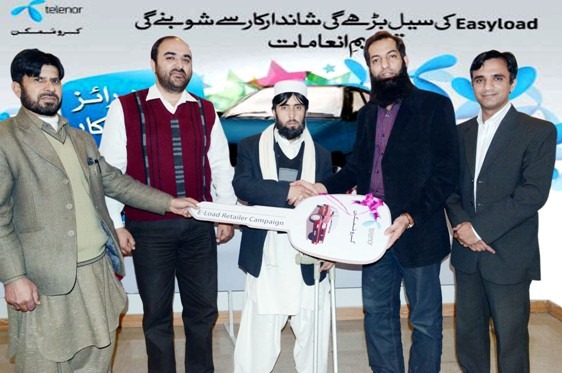
Purpose is to recognize their efforts by gave away prizes which included
Picture shows (R-L) Farhan Tariq, Assistant Manager S&D, Telenor Pakistan and Malik Faisal Qayyum, Director Sales & Distribution, Telenor Pakistan handing over 800CC car keys to the bumper prize winning retailer Bakht Wazir; standing next to him are Shahbaz Ali Agha, Regional Director North-2 and Telenor Buner Franchisee Taj Wali Shah. Related posts:
To read more, click: Telenor Rewards its Retailers      |


 Ufone
Ufone
| You are subscribed to email updates from Pro Pakistani To stop receiving these emails, you may unsubscribe now. | Email delivery powered by Google |
| Google Inc., 20 West Kinzie, Chicago IL USA 60610 | |


0 comments:
Post a Comment